There is a reason why so many people are opting for refractive laser eye surgery.
There is a reason why so many people are opting for refractive laser eye surgery: it really can improve eyesight, and in many cases drastically. Refractive surgery provides a number of very important advantages. There is typically little or no post-operative discomfort. Recovery is fast and complications are extremely rare. Vision returns quickly, usually without the need for glasses or contacts.
The LASIK (Laser Assisted In-Situ Keratomileusis) procedure combines the cool beam of an excimer laser with the skill of a surgeon to correct common refractive errors such as myopia (nearsightedness), hyperopia (farsightedness), and even astigmatism. LASIK gently but effectively reshapes the cornea, one of the primary focusing mechanisms of the eye.
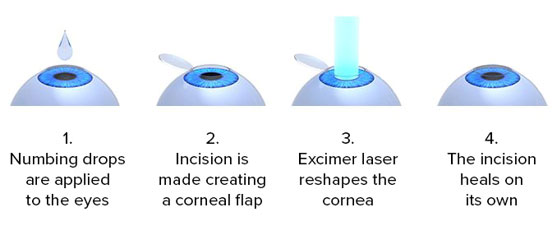
Prior to LASIK surgery, numerous tests will be performed on your eyes to determine the amount of correction needed. A computer, controlled by your LASIK eye surgeon, is used to precisely calculate the exact amount of cornea that needs to be removed for each person’s individual eyes.
LASIK is usually performed as an outpatient procedure using topical anesthesia with drops. The process itself generally takes about fifteen minutes. The surgeon creates a flap in the cornea with a microkeratome. The flap is lifted to the side, and the cool beam of the excimer laser is used to remove a layer of corneal tissue. The flap is folded back to its normal position and sealed without sutures. The removal of corneal tissue permanently reshapes the cornea.
A shield protects the flap for the first day and night. The vision should be clear by the next day. Healing after surgery is often less painful than with other methods of refractive surgery since the laser removes tissue from the inside of the cornea and not the surface. If needed, eyedrops can be taken for pain and usually are only required for up to one week.
Some people experience poor night vision after LASIK. The surgery may result in under correction or overcorrection, which can often be improved with a second surgery. More rare and severe complications include a dislocated flap, epithelial ingrowth, and inflammation underneath the flap. Most complications are managed without any loss of vision. Permanent vision loss is very rare.
The ideal candidate for LASIK is at least 18 years old. They have a stable refractive error within the correctable range, are free of any eye diseases, autoimmune, or immunodeficiency diseases, and are willing to accept LASIK’s potential risks, complications, and side effects.